



2026-7-28
(Courtesy of Taiwan Panorama July 2026)
Lynn Su /photo bycourtesy of Turumoan Whale Watching
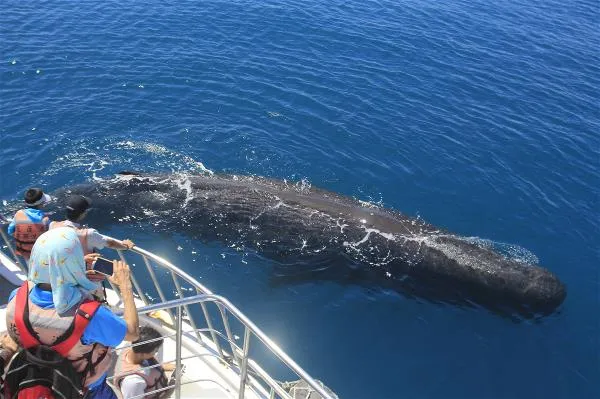
Taiwan has long been poetically known as “Kun Island” after the legendary great kun fish swimming in the sea. Blessed by its island geography, Taiwan’s blue summer waters draw people toward the ocean. Beyond playing around on beaches and in waves, another alternative is offered by Turumoan Whale Watching, which helped launch Taiwan’s cetacean-watching industry in 1998. The firm invites visitors to experience the depth and wonder of Taiwan’s seas with just one boat ticket.
As long ago as 1851, Herman Melville’s classic Moby-Dick depicted a whaling vessel operating in the waters off of “Formosa,” as Taiwan was then known. Today, however, the age of whale hunting, now highly controversial, has given way to a new conservation consciousness: People have set down harpoons and picked up cameras.
Bringing the sea within reach
When Turumoan Whale Watching began operating in Hualien in 1998, whales and dolphins were still extremely rare sights for most people, and they were encountered almost exclusively by fishermen at sea.
To bring more people closer to the ocean and to Taiwan, marine writer and fisherman Liao Hung-chi gathered like-minded friends to establish the Kuroshio Ocean Education Foundation in 1998, taking on the work of marine education. At the same time, Lin Chen-li helped establish Turumoan as a whale-watching company that would not be run for profit alone. The two sides agreed that Kuroshio volunteers would serve as onboard guides on every trip.
“Looking back, wasn’t that what we now call a ‘social enterprise,’ ‘corporate social responsibility,’ or ‘local revitalization’?” says General Manager Lu Shih-ming, who now oversees operations as Chairman Lin has stepped back from the front line. Liao, who helped pioneer whale watching in Taiwan and still provides on-deck guide services to passengers, is respectfully known among the team as “the founding father of Taiwan’s whale-watching industry.”
Life beside the Kuroshio
Not everyone wants to live beside a busy road. But when that road is a powerful ocean current—a highway at sea that is part of the natural environment—the benefits are immense.
The warm Kuroshio Current, which originates in the Philippines, flows northward along Taiwan’s east coast and continues toward Japan. Warmer than surrounding waters, clear, and deep blue, this “highway” moves swiftly through the Pacific at a speed of between 100 and 200 centimeters per second. Where the seabed drops steeply, the current surges upward, bringing nutrients to the surface and drawing migratory sea dwellers such as mahi-mahi (dolphinfish), billfish, and tuna.
Whales and dolphins are also among those drawn here. According to Turumoan, its whale-watching boats encounter cetaceans on more than nine out of ten trips.
Ray Chin, Taiwan’s first professional photographer specializing in underwater cetaceans and a Kuroshio volunteer, says Taiwan’s greatest advantage as a whale-watching destination is its biodiversity: Of roughly 90 cetacean species worldwide, about 30 have been recorded in waters around Taiwan.
Beyond whale watching
Turumoan has never limited itself to whale watching. Lu Shih-ming recalls a long list of ventures that may seem to fall outside the company’s core business: giving talks at schools, collaborating with theater groups, turning an idle railway cultural park into a cultural center, inviting artist Chen Sheng-wen to exhibit a life-size sperm whale artwork in Hualien, and working with like-minded local businesses to shape a slower, more locally rooted approach to traveling through Hualien. These ventures were certainly fun, but they also built name recognition. Turumoan not only weathered the Covid-19 pandemic and the April 3 Hualien earthquake, business has continued to grow, and in 2026 the company added a fourth boat.
Why do visitors specifically choose Turumoan? Much of the answer lies in its rich pre-departure briefings and guide services. Its boats also follow responsible whale-watching principles: They do not use sonar to harass whales and dolphins; when cetaceans are sighted, they first keep their distance and idle while waiting for the animals to approach; and they avoid chasing or disturbing them for extended periods.
Beyond its basic two-hour whale-watching trip, Turumoan offers a range of special sailings: These include a 3.5-hour Qingshui Cliff route; the five-hour “Visit the Pacific Sperm Whale π Project” trip; the “Marine Maze” itinerary organized in cooperation with Fish Bar to explore fixed-net fishing grounds at sea; photography trips led by Ray Chin; and stargazing voyages featuring commentary by Chen Kuan-jung, chairperson of the Hualien Amateur Astronomers Association.
These unconventional trips, often developed with local experts and groups, reflect Turumoan’s years of work across different fields. They also help visitors from afar discover the abundant resources of Taiwan’s East Coast, where mountains and sea meet.
With just one boat ticket, visitors can experience the delights of Hualien’s mountains and waters.
