2026-6-9
(Courtesy of Taiwan Panorama May 2026)
Cathy Teng /photo by Lin Min-hsuan /tr. by Phil Newell
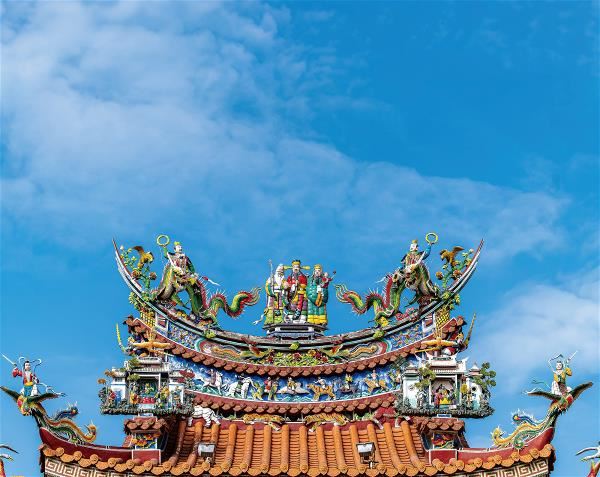
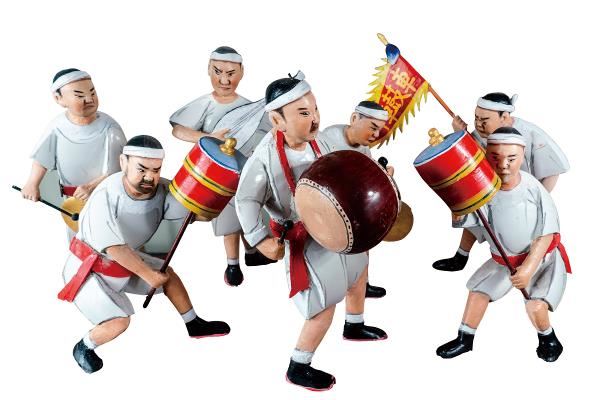
On the roof ridges of Taiwanese temples there are often many colorful characters seemingly in dynamic motion. These fascinating decorative figures are made by combining ceramic shards using the jiannian (“cut and paste”) technique.
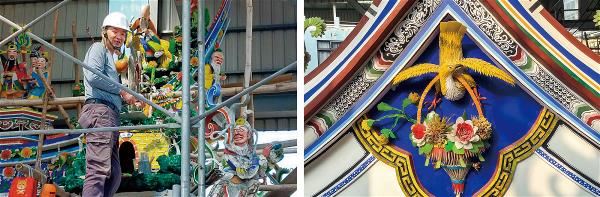
However, exposed to the elements over long periods of time, these dazzling works inevitably suffer damage, even as the craft of cut-and-paste ceramics has steadily declined over the years. Ye Mingji, born into a famous family of jiannian masters from Tainan, took over the family business from his father, Ye Jinlu, with the aim of transitioning his métier from temple decorations into a fully-fledged art form.
Extolling cut-and-paste ceramic art
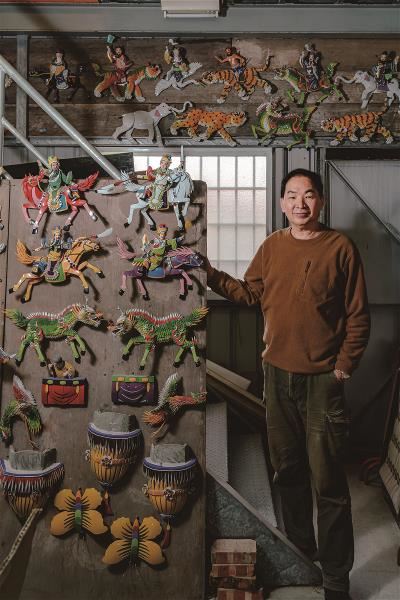
Entering Ye Mingji’s workshop in Tainan’s Annan District, works produced by Ye and his father are everywhere, hanging on walls and standing on surfaces. It is as if temple-roof-ridge scenery has been relocated indoors.
Ye Mingji grew up in a famous family of jiannian craftsmen, but when he was young he had no intention of taking over the family business. It was only after his father repeatedly tried to persuade him, using a “good cop, bad cop” approach, that he finally agreed to “jump in.”
In the realm of cut-and-paste ceramics, the name Ye Jinlu has long been famous. However, public understanding of this craft is limited. Ye Mingji says frankly that one of the conditions he imposed for taking over from his dad was that he wanted to promote jiannian as an art form, to enable more people to see its value.
Transforming cut-and-paste ceramics
Ye Mingji recalls that when he once took his father to visit a temple where the latter had done work in days gone by, they discovered that the cut-and-paste works on the “character blocks” inside the temple (wall panels traditionally decorated with stories of famous figures in relief sculpture) were corroded and discolored by moisture. He told the temple he would repair them free of charge, but was told that a decision had already been made to remove them and replace them with new panels. Unwilling to see these exquisite works disappear, he bought them from the temple.
Back at the family workshop, these figurines were repaired and framed, transforming them into collectible, displayable works of art. Some art collectors even approached Ye with a view to purchasing them. “When people have the chance to see these works up close, they can’t take their eyes off them.”
Beyond roofs
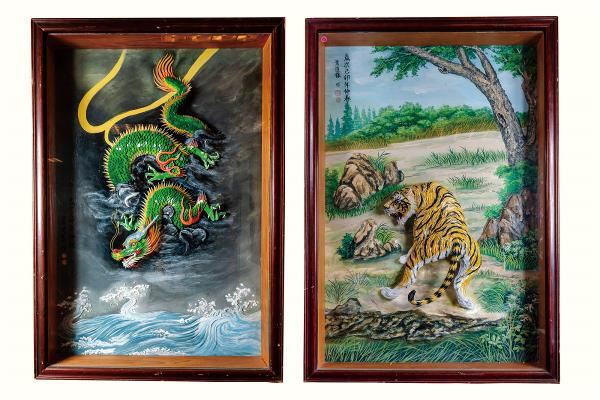
Traditionally, cut-and-paste ceramic works have been mostly attached to temple character blocks or rooftops. They are mainly seen from one direction only, with no need to finish them up on the back side. “However, this is a severe shortcoming if one wants to promote jiannian internationally,” Ye explains. “You can’t stop at one perspective; you have to make complete 3D works.”
When Ye proposed his idea for 3D works to his father, his dad didn’t approve. So he used his own free time to learn by trial and error, taking six or seven months to finally complete his first 3D cut-and-paste piece, Dragon Looking Skyward. This depiction of a dragon flying gracefully, which can be appreciated from any angle, was even displayed in Brisbane, Australia as part of city-to-city exchanges.
Since then, Ye Mingji has continually produced new creations, even inspiring his father to enthusiastically work with him. They have made a large number of new works together.
One temple, three generations
When talking about his most memorable projects, Ye Mingji mentions the Hamaseng Daitienkung Temple in Kaohsiung. Built in the 1950s, the temple is today registered as a historic building. “The cut-and-paste ceramics were all done collaboratively by a team led by my grandfather Ye Zong and including my uncle Ye Jinyi and my father, Ye Jinlu,” says Ye Mingji.
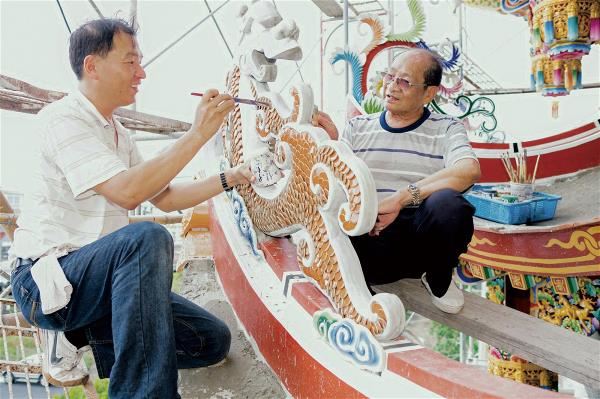
After more than half a century of exposure to the elements, Daitienkung underwent a major renovation, and Ye Mingji handled the job at this venue that is so meaningful for his family. Considering his ineradicable attachment to this house of worship, he spared no expense to raise the standards of his renovation work and devoted himself to the project for three years. Displaying the achievements of generations of craftsmen from the same family at one site, the jiannian wall decorations seem to embody a dialogue that transcends time. We seem to see three generations working side by side, quietly passing along their legacy.